Entities Actions
The application.entities object provides access to the entities API (all the different functions you can use to interact with entities). Shesha uses modules to group different parts of the application, and entities are grouped the same way.
To get the entities from a specific module, use this pattern:
application.entities.[module-name-here].[entity-name-here]
To call one of the CRUD functions on that entity, use this pattern:
application.entities.[module-name-here].[entity-name-here].[function-name-here]
For example, to access the entity Shesha.Core.Organisation from the Shesha module, use this pattern:
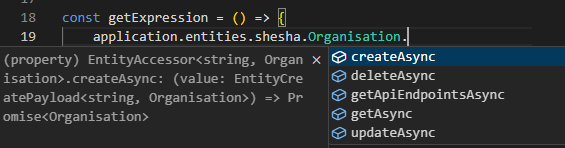
application.entities.shesha.Organisation
Each entity type exposes 5 methods:
createAsync- create a new entity.getAsync- fetch entity data from the back-end.updateAsync- update an entity.deleteAsync- delete an entity.getApiEndpointsAsync- get the API endpoints available for this entity.
All listed operations use the default CRUD API endpoints and don't require manual usage of URLs.
createAsync - create a new entity
try {
 const newPerson = await application.entities.shesha.Person.createAsync({
  firstName: 'Jane',
  lastName: 'Doe',
  emailAddress1: 'test@mail.com',
  mobileNumber1: '1234567890',
 });
 actions.showMessage.success('Person created successfully!');
}
catch (error) {
 console.error('Failed to create person.', error);
}
getAsync - fetch entity data from the back-end
const personId = '...';
try {
  const person = await application.entities.shesha.Person.getAsync(personId);
  const { firstName, lastName } = person;
  actions.showMessage.success(`Person data fetched. First name: '${firstName}', Last name: '${lastName}'`);
}
catch (error) {
  console.error('Failed to fetch person data. ', error);
}
updateAsync - update existing entity
updateAsync requires the entity's id. Every other property is optional, so only the fields that changed need to be included in the payload.
try {
 const updatedPerson = await application.entities.shesha.Person.updateAsync({
  id: personId,
  emailAddress1: 'newemail@mail.com',
  mobileNumber1: '5555555555',
 });
  actions.showMessage.success('Updated person successfully.', updatedPerson);
}
catch (error) {
 console.error('Failed to update person.', error);
}
deleteAsync - delete an entity
try {
	await application.entities.shesha.Person.deleteAsync(personId);
	  actions.showMessage.success('Deleted person successfully.');
}
catch (error) {
	console.error('Failed to delete person.', error);
}
getApiEndpointsAsync - get the API endpoints for this entity
Returns the CRUD endpoints (create, read, update, delete) that back this entity type, each as an { httpVerb, url } object. This is useful when you need to call an endpoint directly, for example with http, instead of going through createAsync/getAsync/updateAsync/deleteAsync.
try {
  const endpoints = await application.entities.shesha.Person.getApiEndpointsAsync();
  console.log(endpoints.read.httpVerb, endpoints.read.url);
}
catch (error) {
  console.error('Failed to get API endpoints.', error);
}